

Reading methodology
How Our Tarot Readings Work
This page explains how tarot readings work on the Tarotoo website, from card selection and AI interpretation to expert review of the methodology.
For definitions of the tarot and technical terms used on this page, see the Tarotoo Glossary.
This page describes the Tarotoo website. The Tarotoo mobile apps are separate experiences under the same brand and may differ in features, tarot spreads, reading methods, and safeguards.
- Last updated October 14, 2026
The Tarotoo Reading Process at a Glance
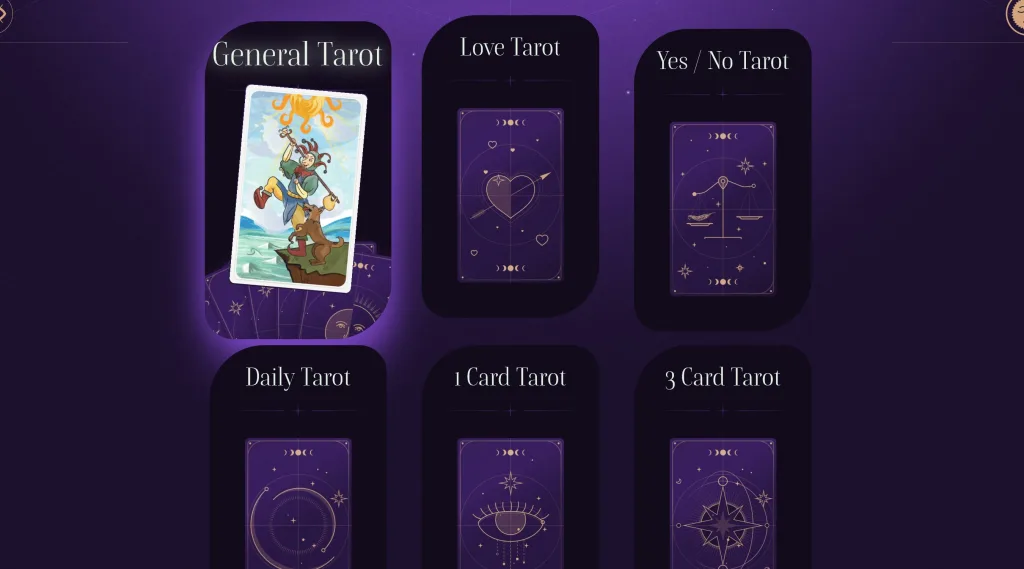
Choose a Spread
Select the tarot spread that best matches your question.
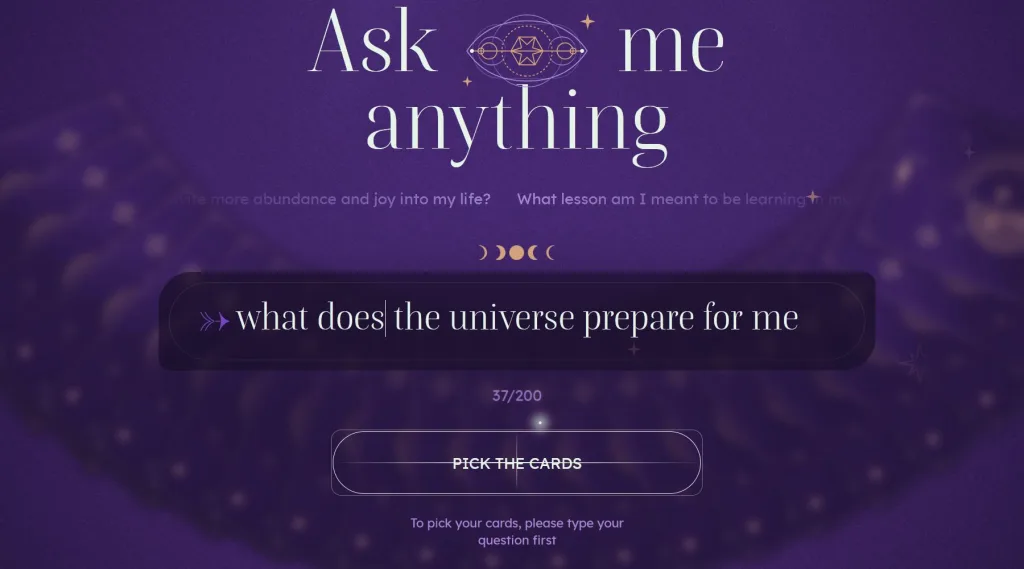
Add Your Context
Enter your question or the details requested by your spread.
Select Your Cards
Choose your cards intuitively and let your selection shape the reading.
Get Your Reading
Receive an AI interpretation based on tarot symbolism, card positions, and your question context.
When a reading asks for a question, Tarotoo checks it before you select cards. Sensitive questions may receive support information and an optional alternative question for reflection. If a potential crisis or urgent safety concern is identified, the website directs users toward human help instead of continuing with a tarot reading. See Safety Rules and Sensitive Questions.
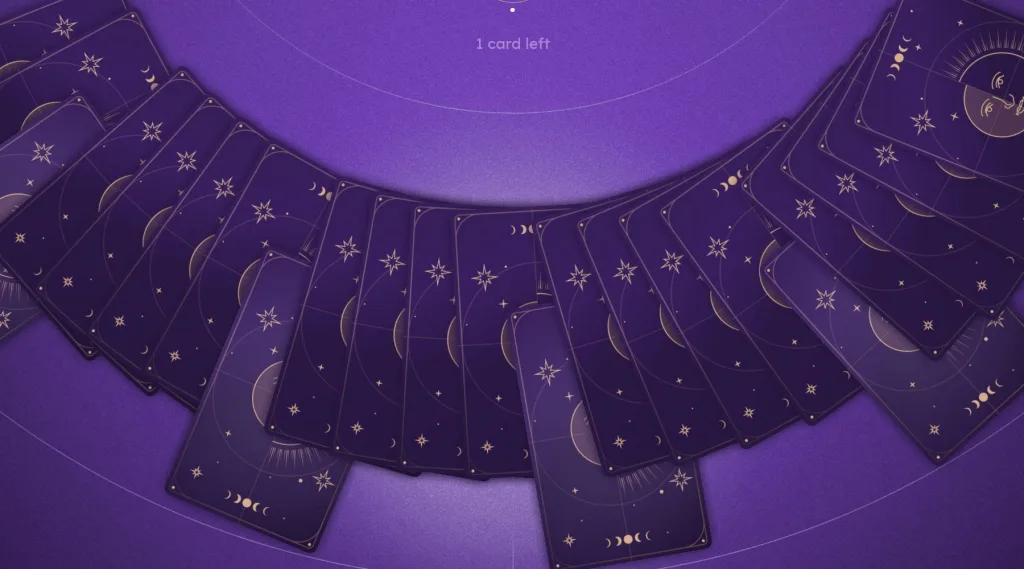
You choose the cards
Before each reading, Tarotoo digitally randomizes the order of the available cards. You can also shuffle the deck again using the Shuffle button before making your selection. You then choose the cards yourself from the interactive deck. The AI does not control the shuffle, choose cards, or use your question or personal information to influence which cards you select.
View the screen-by-screen guide
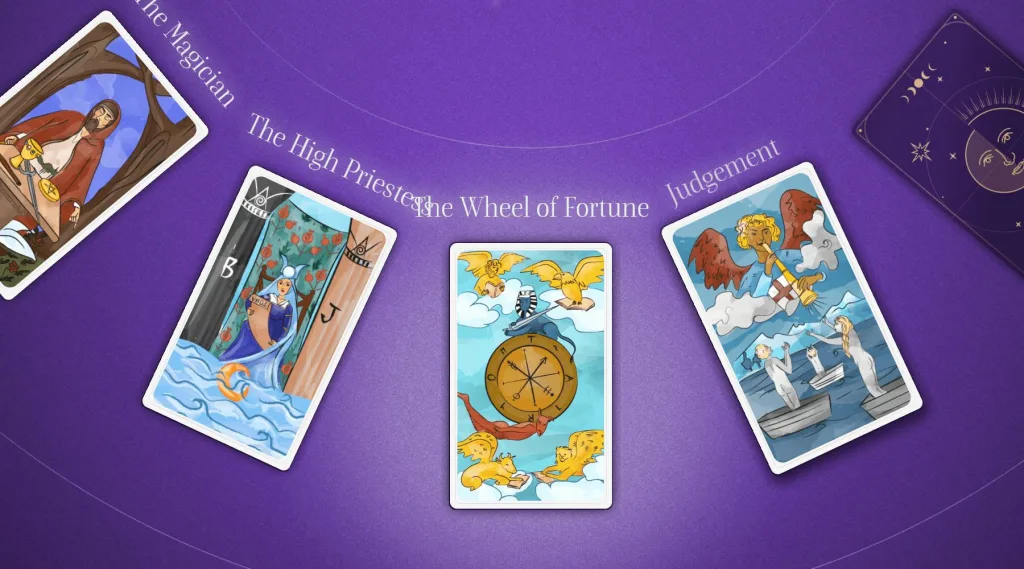
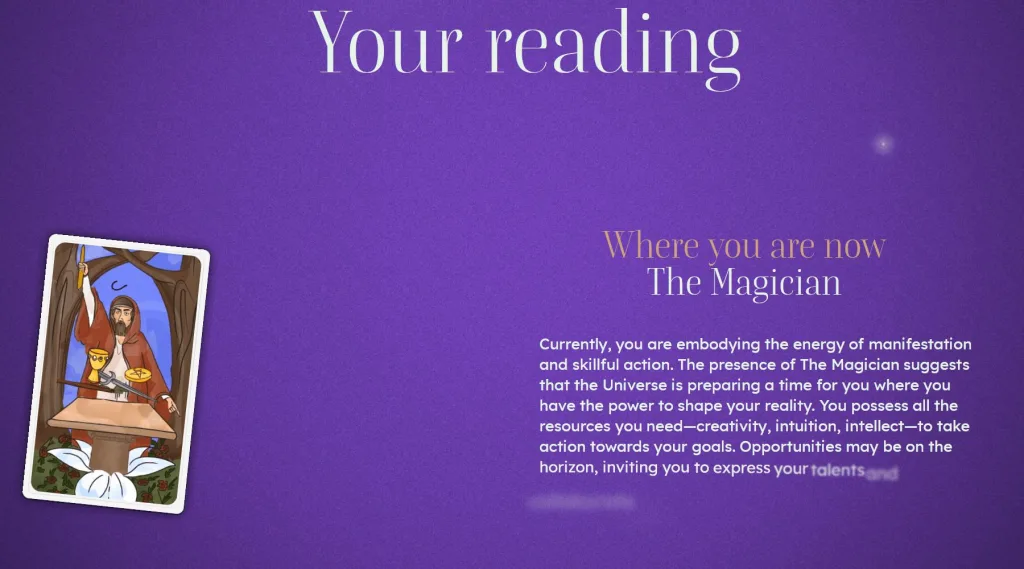
The following example shows how to complete a tarot reading on the Tarotoo website.
How AI Works at Tarotoo
Tarotoo uses artificial intelligence to generate personalized written interpretations based on tarot symbolism, structured card meanings, and the information provided during a reading.
At a high level, the process has three stages: retrieving the relevant card information from Tarotoo’s dataset, combining it with the user’s question and reading context in a structured prompt, and using an AI language model to generate the written interpretation.
Retrieve
Relevant card information
Structure
Question and reading context
Generate
Written interpretation
The dataset provides structured source material, but the completed interpretation is generated for the current session. Tarotoo does not select a prewritten reading.
Tarot Symbolic Framework and Dataset
Tarotoo’s tarot symbolic framework is an organized collection of tarot card meanings and symbolic associations used to support the interpretation of selected cards. It is based primarily on the Rider–Waite–Smith tarot system, together with other established works in classical tarot.
The Rider–Waite–Smith deck was first published in 1909. Its imagery and symbolism have influenced many contemporary tarot practices and provide the main traditional foundation for Tarotoo’s interpretations.
Tarotoo prepared the dataset’s interpretive text with generative AI, guided by historical tarot references and previously published Tarotoo material. All 78 card records were subsequently edited by Tarotoo to improve consistency across meanings, terminology, tone, and categories. The historical references include A. E. Waite’s The Pictorial Key to the Tarot and the Golden Dawn’s Book T. Categories such as love, career, mood, spiritual themes, and yes/no classifications are contemporary adaptations of card symbolism.
This information is stored in a structured, machine-readable tarot dataset that includes upright and reversed meanings, keywords, thematic interpretations, planetary and zodiac associations, career interpretations, and other card-related information.
Tarotoo’s public dataset covers all 78 cards, while website readings currently use the 22 upright Major Arcana and retrieve only the information relevant to the selected reading.
Tarotoo matches each selected card to its corresponding dataset record and supplies the relevant meanings to the AI alongside the reading context. This is a direct form of retrieval-augmented generation (RAG): card identifiers determine which source material is retrieved, without requiring semantic search or a vector database.
Using a structured dataset helps keep interpretations aligned with Tarotoo’s tarot symbolic framework and reduces the likelihood of unsupported, inconsistent, or invented card meanings.
Tarotoo publishes the complete 78-card dataset as open data. See our Open Data & Developer Resources page for the dataset, documentation, methodology, and available developer tools. You can also explore all cards in our interactive card meanings guide.
AI Prompts and Logic
AI prompts are structured inputs sent to the AI language model. Tarotoo’s AI logic refers to the processes used to select and organize the information and instructions included in each prompt. Each prompt includes:
- the user’s question and any additional information provided;
- the selected spread;
- the meaning of each card position;
- the chosen cards;
- relevant card meanings, keywords, and other information retrieved from Tarotoo’s dataset;
- instructions for interpreting relationships and combinations between the cards; and
- additional instructions governing the reading’s structure, language, tone, and safety.
Once the selected cards and reading context are available, the completed prompt is sent to the AI model to produce the interpretation. Question screening takes place earlier, before card selection. If a sensitive question receives a reflective alternative and the user chooses to continue, the reading focuses on that alternative question, with additional instructions to keep the interpretation within reflective boundaries. See Safety Rules and Sensitive Questions for details.
AI Language Model and API
Tarotoo uses an AI language model provided by OpenAI. The completed prompt is sent through an encrypted API connection, and the model uses the supplied information and instructions to generate and return the written interpretation.
What Influences Each Reading
Each Tarotoo reading is shaped by several elements:
- Your question: gives the reading its context and focus.
- The spread: defines the structure of the interpretation, such as past, present, future, or yes/no.
- The cards selected: provide the symbolic foundation of the reading.
- Card positions: help explain how each card relates to the question.
- Card combinations: show how different symbols interact together.
Your Question
Your question gives the interpretation its focus. Any additional information you submit helps connect the card symbolism to the situation you describe. Changes in your wording or the information provided may lead to a different interpretation of the same cards.
Spreads
You can choose from One-Card, Yes/No, Past–Present–Future, Daily Tarot, and Tarotoo’s two original five-card spreads. Each spread organizes the selected cards into a different structure, allowing you to explore a single theme or several aspects of a situation.
Yes/No Tarot
In the Yes/No reading, you select two cards and receive a yes, no, or maybe response with an AI-generated explanation. The interpretation draws on the selected cards’ upright meanings and your question. Treat the result as a symbolic perspective for reflection, rather than a prediction, a calculated probability, or an instruction.
Daily Tarot
Daily Tarot uses three cards to explore love, mood, and spiritual growth. Your name, date of birth, and the current date provide additional context for its astrology and numerology elements, such as your zodiac sign. These inputs help personalize the symbolic interpretation; they do not establish facts about your personality or predict how your day will unfold.
The Cards
On Tarotoo, readings on the website use the Major Arcana, a set of 22 cards that represent core life themes, transitions, and archetypal experiences. Because these cards focus on broader patterns and key moments, they are well suited for clear and meaningful interpretations.
Card Positions
In structured spreads, each position has a specific role, such as past, present, or future. This helps define how each card should be interpreted in relation to your question. The same card can have a different meaning depending on where it appears. For example, a card in the “past” position may describe a previous influence, while in the “future” position it may point to a possible direction.
Card Combinations
Tarot readings are not based only on individual card meanings. The relationship between cards can change the tone and direction of the interpretation. For example, one card may represent tension, while another may suggest resolution, movement, or emotional clarity.
Tarotoo analyzes how cards work together within the spread, helping create a more complete interpretation than a simple list of separate card meanings.
Example of Context in a Reading
If you ask about a relationship and draw The Lovers, the interpretation may focus on emotional connection, choices, harmony, or alignment. If the same card appears in a different spread, the focus may shift toward values, commitment, and choosing what feels right. This is why context matters. Tarotoo does not interpret cards as fixed answers, but as symbols shaped by the question, spread, and surrounding cards.
How Your Intuition Shapes the Reading
Your intuition can shape a tarot reading in two main ways: through the cards you choose and through the meaning you take from their interpretation.
First, intuition may guide your attention as you select your cards. You may feel drawn to a particular card without immediately knowing why. Tarotoo does not measure or verify intuition, but the cards you personally choose become part of the reading.
Tarotoo then generates an interpretation using your question, selected spread, card positions, traditional tarot meanings, and symbolic relationships between the cards. The AI cannot know your complete situation, thoughts, or emotions, so its interpretation is based only on the information provided during the reading.
Intuition also plays a role as you reflect on the result. Different aspects of the interpretation may connect with different experiences, emotions, or circumstances. The same tarot symbol may feel relevant in different ways to different people, so you decide which ideas are meaningful and how, if at all, they relate to your life.
Animated Cards
Each Tarotoo card is presented as an original animated video created by a professional illustrator and animator. Motion and visual detail bring the traditional symbolism to life, helping create atmosphere, anticipation, and a more immersive reading experience.
The Expert Review Process
The tarot reading process, spreads, reading pages, symbolic framework, and AI prompts and logic used on the Tarotoo website were reviewed by Inbaal, a professional tarot reader and astrologer with over 25 years of experience.
Inbaal tested the website’s spreads directly, submitting different questions and examining the generated readings. Her review covered:
- Traditional tarot symbolism: Consistency of card meanings and symbolic associations with established tarot practice, and their appropriate application to the reading.
- Question relevance: How clearly the interpretation addressed the question and connected the selected cards to the situation described.
- Spread positions: How each position shaped the interpretation, such as a card representing a past influence, a present situation, or a possible future direction.
- Card combinations: How supporting themes, contrasts, and relationships between cards formed a coherent reading rather than disconnected descriptions.
- Intuition and personal judgment: Encouragement to reflect through personal intuition and experience, with freedom to decide which ideas felt meaningful and to question or disregard interpretations.
- Clarity, tone, and safety: Readable language that avoided manipulative or fear-based wording and did not reinforce distressing beliefs about supernatural threats.
- Uncertainty and professional boundaries: Language that acknowledged uncertainty and avoided presenting tarot as a guarantee of future events or a substitute for professional advice.
- AI prompts and logic: How the instructions guided the interpretation of card meanings, combinations, spread positions, and the user’s question.
Her feedback helped refine the symbolic and interpretive foundations used to guide Tarotoo’s AI-generated readings. She periodically reviews the methodology when new spreads, prompts, or features are introduced.
Safety, Privacy and Independence
Safety Rules and Sensitive Questions
User safety is a priority in how we develop Tarotoo. Our AI prompts include safety instructions designed to take priority over ordinary tarot interpretations. These instructions address fear-based language, psychological pressure, and distressing beliefs about supernatural threats.
Our AI safety checks are designed to identify questions seeking guidance on medical, legal, financial, mental health, major career, or personal safety decisions. The safety check runs when a user submits a question, before card selection.
If the check identifies a question requiring a safety response, Tarotoo displays a safety message instead of directly answering the question through tarot. The response provides general information, encourages the user to seek appropriate professional support when relevant, and may offer a rewritten reflective question so the user can continue with a symbolic reading focused on emotions, perspectives, or considerations rather than on making the decision itself.
Reflective continuation is not offered for situations involving an immediate crisis or urgent safety concern. In these cases, the AI is instructed to prioritize immediate human support and encourage the user to seek appropriate help.
Example question: “Should I invest in Microsoft?”
Example response excerpt: “Thank you for sharing your question about investing in Microsoft. It’s important to consider that investment decisions should be based on thorough research and tailored advice from a qualified financial advisor.”
Example reflective question: “What feelings do I have about taking risks?”
This example shows a financial safety response that encourages research and qualified professional advice without using tarot to make the investment decision. The suggested reflective question lets the user continue with a symbolic reading focused on their feelings about taking risks. View example screenshot (in English, opens in a new tab).
Responses and suggested reflective questions may vary.
Dr. LeMeita Smith, PhD, LPC-S, a licensed professional counselor, tested and reviewed the website’s responses to ordinary questions, sensitive decisions, and crisis or emergency concerns. Read her safeguards review.
AI Reading Limitations
AI-generated readings may be inaccurate, incomplete, overly general, or inappropriate. They are intended for entertainment and personal reflection, not as factual statements, guaranteed predictions, diagnoses, or a substitute for medical, legal, financial, or mental health advice.
Even when the question and selected cards remain the same, AI generation may produce different wording, emphasis, or interpretations. Differences between readings do not establish that your circumstances or future have changed.
Tarotoo cannot verify another person’s private thoughts, feelings, intentions, or actions. When a reading discusses relationships or other people, those passages offer symbolic perspectives for reflection rather than factual findings about them.
We recognize that our safety instructions may not identify every sensitive situation or lead to an appropriate response every time. To make these boundaries clear before users begin, we also display a localized notice next to each reading start button: “18+. AI-generated readings. For entertainment only. Not a substitute for professional advice.”
Individual readings are generated automatically and are not manually reviewed before being shown. Expert review applies to the overall tarot-reading methodology, not to each response.
Tarotoo is not an emergency or crisis-support service. Our Get Help Immediately page provides crisis resources and other support options. Further details about the purpose and limitations of the readings are available in our Disclaimer.
Commercial Independence
Affiliate partners and affiliate compensation do not influence card selection, Tarotoo’s tarot card meanings, symbolic framework, reading methodology, AI prompts and logic, or individual reading results.
Affiliate promotions appear in visually separate promotional sections and are not included in tarot reading text.
For more information, please read our Affiliate & Revenue Disclosure.
Privacy, Security and Data Processing
Tarotoo prioritizes your privacy and security. We use encryption to help protect your experience. You do not need to create an account to use the website.
To generate a reading, your submitted information and reading selections are transmitted securely to OpenAI for real-time processing.
To support user privacy, Tarotoo does not store questions, other reading inputs, or completed readings on its servers. Users who wish to keep a reading can copy and save it themselves.
OpenAI does not use API inputs and outputs to train its models by default, and Tarotoo keeps optional API data sharing disabled. OpenAI may retain limited data for abuse monitoring or service operation in accordance with its data-retention policies. More information about how submitted data is processed is available in our Privacy Policy.
Updates and Support
When We Review and Update Our Methodology
Tarotoo’s reading methodology may be reviewed and updated when:
- a new tarot spread, reading type, or feature is introduced;
- significant changes are made to the AI prompts or logic;
- the underlying AI model or technical system is changed;
- user feedback reveals a recurring issue, such as irrelevant, repetitive, unclear, or inappropriate responses;
- expert review identifies an inconsistency in card meanings, spread positions, card combinations, tone, or safety.
Minor technical changes may not require a complete methodology review. However, significant changes that affect how readings are created or interpreted may trigger additional testing and expert review.
Feedback and Support
If you notice an error or inconsistency on this page, think part of the methodology needs further clarification, or encounter a reading that appears inaccurate, unclear, inappropriate, or concerning, please contact us at [email protected].
Feedback may help us identify recurring issues and improve Tarotoo’s prompts, AI logic, symbolic framework, safety instructions, and reading features.
For answers to common questions, visit our FAQ & Help page.